TEC Mounting
 

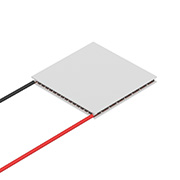
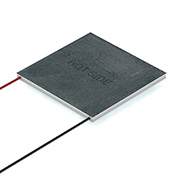
There are three methods of mounting thermoelectric modules:

  1. Adhesive bonding using a thermally conductive advesive such as epoxy.
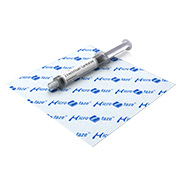
  2. Compression assembly using thermal interface materials such as thermal grease or thermal sheets.
  3. Solder mounting.

A combination of these methods can be used, such as solder mounting the TEC bottom and epoxy mounting the TEC top.

Metallization on the hot and/or cold ceramic faces allows soldering as a means of mounting. Keep in mind a TEC that has no metallization (bare lapped ceramic face) on either side cannot be mounted using solder.

Adhesives and greases are prone to outgassing, therefore they may not be as appropriate for all applications such as vacumns and optical enclosures. Contact us for engineering assistance in selecting outgass safe products.


Surface Preparation
Surface preparation is important when using any of the assembly methods. No matter which method is used, the mounting surface should be flat to less than +/-0.025 mm (+/-0.001 inches) over the TEC mounting area. In addition, the surface should be clean and free from all dirt, oil, scratches and burrs. When multiple TEC's are placed in parallel thermally between two plates, the TEC thicknesses should vary no more than 0.02 mm (0.0008 inches) from lowest to highest points.


Mounting with Adhesive Bonding

Typically a thermally conductive adhesive such as epoxy is used to "glue" the TEC to the heat sink or cold plate. An epoxy with a high thermal conductivity is needed to ensure an optimum thermal system.


1. Clean both surfaces with acetone 2-3 times with a cotton swab or similar lintless applicator. Use force to reach down into the micro surface scratches and remove any oils and dirt. If possible, use an ultrasonic cleaner (do NOT clean TECs in an ultrasonic) to first clean in a mild detergent, rinse, dry, and then again in acetone. Allow all parts to dry completely. [Once completed, do NOT touch the cleaned surfaces. Oils from the skin will make a low strength epoxy bond and will also decrease the heat transfer.]


NOTE: It is recommended that acetone and cotton swabs be available so any excess adhesive (uncured) may be removed.


2. Use Thermally Conductive Epoxy such as Arctic Silver Thermal Adhesive. Follow the instructions on the package carefully. [Be certain to mix the two parts thoroughly or the epoxy will not cure properly. Do not mix the two components ON the TEC or surface to be bonded to. Always mix the two epoxy components on a plastic or metal surface, then apply to the TEC or mounting surfaces. Do NOT mix epoxy on a porous surface such as paper or cardboard as the surface may absorb crucial components of the epoxy compound.]

Generaly, epoxy working time is approximately one hour. Check package for further information.
CAUTION: Avoid prolonged or repeated breathing of vapor, and use with adequate ventilation. Avoid contact with eyes, skin, or clothing. In case of contact with eyes or skin, flush immediately with plenty of water and seek medical attention.


3. Coat the ceramic of the TEC with approximately a 0.05 mm (0.002 inches) thick layer of epoxy. Use a spreader to apply a thin even layer. Make sure all of the ceramic face is coated.

4. Place the TEC on the heat sink and gently rotate the TEC back and forth in a clockwise-counterclockwise motion, squeezing out the excess epoxy.


5. Using a clamp or weight, apply pressure of 50-100 psi, and cure for 2-4 hours at 60°C to maximize thermal and mechanical properties. Curing time at room temperature is 24 hours.


Mounting with the Compression Method

Compression assembly is by far the most common method, but not necessarily the easiest. It is essentially a TEC "compressed" between a cold plate and a heat sink and maintained in compression by two or more fasteners.

When to Use: When a permanent bond is not desired; when multiple TEC's are used; or when your TEC is larger than 23mm (0.91 inches)


1. Prepare heat sink and cold sink surfaces by machining the module area to within +/-0.025 mm (+/-0.001 inches).


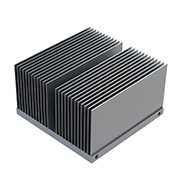
2. Locate bolt holes in your assembly such that they are at opposite sides of the center of the TEC between 1.6 mm to 12.7 mm (0.063 to 0.5 inches) from the sides of the TEC. The bolt holes should be in the same plane line as the fins to minimize any heat sink bowing (bending) that might occur.


3. The recommended hardware is: #4-40 or #6-32 stainless steel screws, Belleville spring type washers, flat washer, and insulating fiber washers to thermally isolate the screw from the heat sink.


4. Remove all burrs. Then, clean and prepare mounting surface with methanol or acetone.


5. Apply a thin 0.05 mm layer of thermal grease to the hot side of the TEC. Place the TEC on the heat sink and rotate back and forth in a clockwise-counterclockwise motion, squeezing out the excess thermal grease until resistance is felt.


6. Repeat step 5 and rotate cold plate back and forth, squeezing out the excess thermal grease.


7. In a two module system, torque the middle screw first. Be careful to apply torque in small increments, alternating between screws. In general, apply less than 200 psi to the TEC. It is of the utmost importance that the screws are tightened evenly in small increments back and forth. If one screw is overtightened, then the tightening of the second screw may crush the TEC.


Mounting with Solder

Solder mounting has the potential to offer the greatest heat transfer capacity, but can also be the trickiest method of all.

When to Use : When you need minimal outgassing; when the TEC is smaller than 23 mm; when you need a high-strength junction; when the highest thermal conductivity is required.

Procedure:

1. Make sure that the TEC that is to be solder mounted is metallized or pre-tinned. If it is pre-tinned, you must know what the melt temperature of the pre-tinning is. If the TEC is not metallized, i.e., it has a ceramic face, you cannot solder mount this TEC. Call customer service for assistance.

2. Make sure that the surface that the TEC will be solder mounted to is solderable. this means the surface must be either copper, or copper plated, or pre-tinned. The surface must also be flat to within +- 0.001 inches (+-0.025mm) in the area that the TEC is to be solder mounted to. If the surface is not flat enough, it must be machined, ground, or lapped to this level of flatness.

3. Clean the TEC twice with acetone using cotton swabs or other lintless applicator. Use force to reach down into the micro surface scratches and remove any oils and dirt. [Once completed, do NOT touch the cleaned surfaces. Oils from the skin will make a low strength epoxy bond and will also decrease the heat transfer.]

4. Clean the surface that the TEC is to be solder mounted to with acetone 2-3 times using cotton swabs or other lintless applicator. Use force to reach down into the micro surface scratches and remove any oils and dirt. If possible, use an ultrasonic cleaner (do NOT clean TECs in an ultrasonic) to first clean in a mild detergent, rinse, dry, and then again in acetone. Allow all parts to dry completely. [Once completed, do NOT touch the cleaned surfaces. Oils from the skin will make a low strength epoxy bond and will also decrease the heat transfer.]

5. Make note of the TEC's maximum temperature, pre-tinning melt temperature (if any), and the melt temperature of the solder you will use to mount with. You must have a hot-plate or other similar device that can be accurately controlled with a temperature setpoint. The main objective is to raise the temperature of the assembly to just above the mounting solder melt point, but stay below the TEC's maximum temperature.

6. Lightly and evenly flux the surface and the metallized surface of the TEC with the appropriate flux for the solder you are using.

7a. (For a pre-tinned TEC or surface) Place the cold plate or heat sink (to be soldered to) on the hot plate previously heated to the appropriate temperature. Place the TEC tinned side down onto the surface and in the correct and desired final position. Allow several minutes for the surface to reach full temperature. As a test, use a small (.125") piece of solder wire as a "witness" by placing it on the surface (but not on the mounting area) and waiting until it melts and beads up. Once the "witness" has melted, you should see that the pre-tinning on the TEC or surface has melted and is being squeezed out on the sides of the TEC. Position TEC correctly and then turn the hot plate off and allow to cool slowly. Do NOT rapidly cool the assembly.

7b. (Soldering Iron method for tinning non-tinned TEC) With a soldering iron and a new tip, pre-tin the TEC using solder with a melt point below that of the maximum TEC temp. Brighten the metallization on the TEC with 600 grit sandpaper to remove any oxides. Lightly flux with a general purpose Acid Flux. Use small amounts. Melt solder onto the iron tip and then apply iron to TEC and hold. Once you see the solder wet to the TEC, proceed with a swirling motion of the iron tip on the TEC, therby spreading the solder tinning evenly onto the TEC. You can heat the soldering iron to a maximum of 20-30 °C above the melt point of the tinning solder, but extreme care must be taken since many TEC's are constructed with 138°C (min.) solder.
CAUTION: Do not mix solders. Use a separate soldering iron tip for each solder.

7c. (For a non-tinned TEC or surface) Place the cold plate or heat sink (to be soldered to) on the hot plate previously heated to the appropriate temperature. Also place the TEC onto the hot plate or surface, but not on the area to be mounted to. Allow several minutes for the surface and TEC to reach full temperature. As a test, use a small (.125") piece of solder wire as a "witness" by placing it on the surface (but not on the mounting area) and waiting until it melts and beads up. Once the "witness" has melted, apply solder to the mounting area to cover the mounting area as evenly as possible without creating a large pool of solder. Using tweezers or pliers, pick up the TEC and place it onto the solder. Molten solder should squeeze out around the sides of the TEC. Position TEC correctly and then turn the hot plate off and allow to cool slowly. Do NOT rapidly cool the assembly.

8. After assembly has cooled, wash area with appropriate flux remover.

General guidelines:

1. There should be a minimum of at least 20C between melt points used on a single assembly. It is preferred that the "steps" be 40 to 50C, but this is not always possible.

2. Set hot plates or soldering iron to 20-40C above the melt point of solder being used, but make sure that this setpoint is still below the melt point of the TEC or other solder melt point used in the assembly.

3. Do not allow flux to "burn" or sit too long at an elevated temperature. Timing is crucial. Heat, apply solder, assemble, and cool as quickly as possible.

4. If solder, pre-tinning, or copper surface appears tarnished or dull, then it is likely oxidized. Remove oxidation from solder or pre-tinning with a course paper towel until it brightens. Remove copper oxidation with a LIGHT buffing with 600 or higher grit sandpaper. Re-clean parts as necessary.


HOME    ABOUT US    CONTACT US    HELP

Copyright © 2007 Custom Thermoelectric All rights reserved.